If you are a homeowner shopping around for garage floor upgrades, you have likely come across dozens of options online or in local mailers. You call up a local garage floor epoxy company, get a quick quote, and expect a clean, showroom-quality surface that will hold up against heavy vehicles and muddy boots for years to come.
Here is the uncomfortable truth: traditional epoxy is yesterday’s technology.
While many contractors still push standard solvent-based or 100% solid epoxies because they are cheap to source and easy to apply, these floors frequently fail under real-world residential conditions. Within a few seasons, homeowners often face flaking topcoats, tire marks embedded into the surface, and an unsightly yellowish tint near the garage door opening.
Before committing your hard-earned money to a traditional installation, it pays to understand how chemical coatings actually perform and why modern polyurea and polyaspartic systems have fundamentally replaced traditional epoxy.
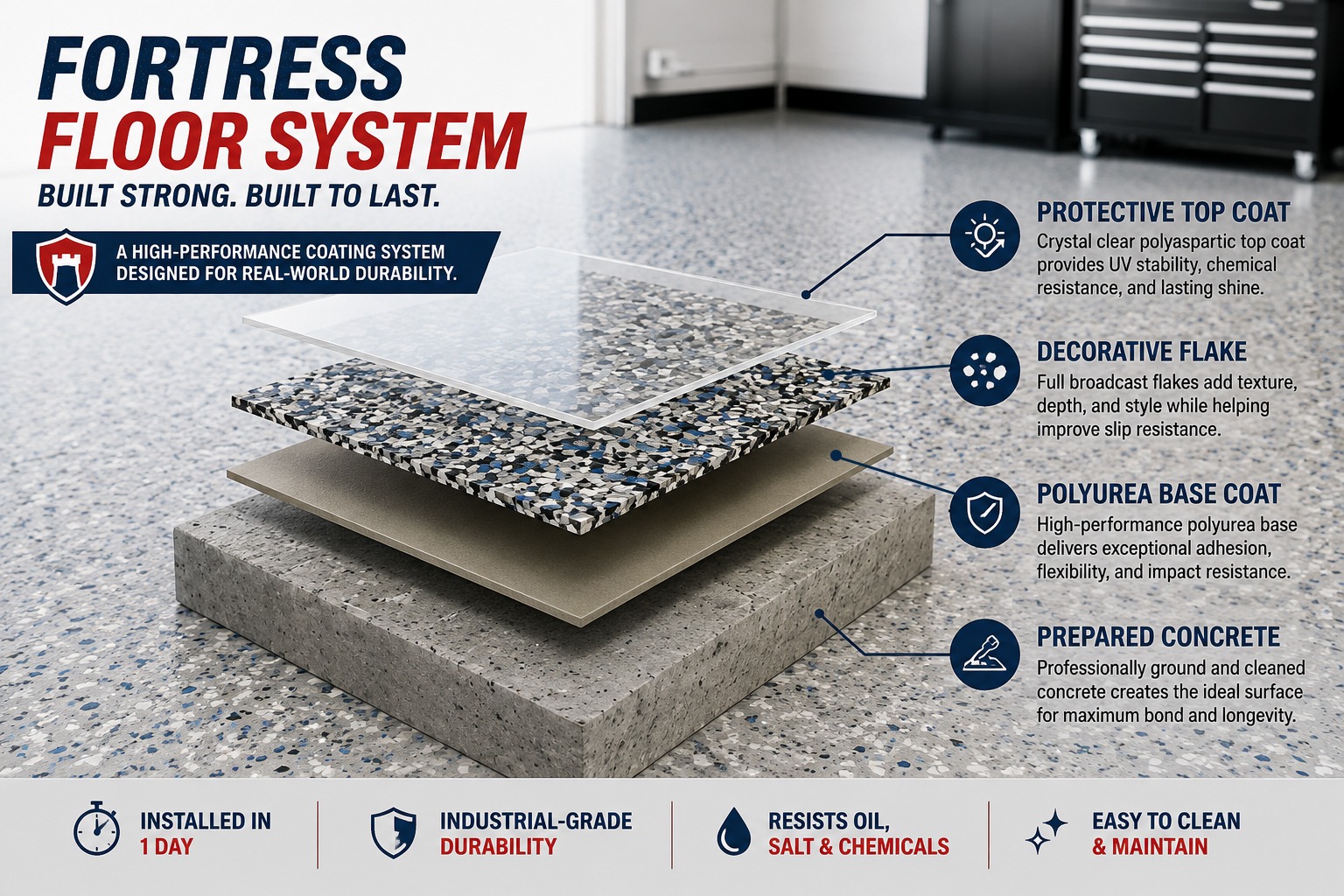
Epoxy vs. Modern Coatings: A Side-by-Side Breakdown
To understand why traditional epoxy fails in residential settings, you have to look at the chemistry under your tires. Pennsylvania experiences distinct seasonal shifts from freezing winter roads treated with road salts to hot summer afternoons. Concrete slabs naturally expand and contract as humidity and outdoor temperatures change.
| Feature | Traditional Epoxy Systems | Modern Polyurea/Polyaspartic Coatings |
|---|---|---|
| Flexibility & Tensile Strength | Rigid and brittle; subject to cracking with concrete shift | Highly flexible; moves naturally with concrete expansion |
| Cure & Return-to-Service Time | 3 to 5 full days | 1 Day (Walkable in hours, drivable in 24 hours) |
| UV Resistance | Ambering/Yellowing under sunlight | 100% UV stable; remains crystal clear permanently |
| Thermal & Hot-Tire Resistance | Susceptible to hot-tire pickup | Heat resistant up to 300°F+; eliminates tire peeling |
| Installation Window | Requires warm, dry conditions | Year-round installation down to freezing temperatures |
Flexibility vs. Rigidity
Epoxy dries into a hard, rigid shell on top of your concrete. When cold Pennsylvania winters freeze the ground beneath your home, that concrete moves slightly. Because rigid epoxy cannot stretch or flex, it loses its bond, cracks, or bubbles up from moisture pressure underneath. Polyurea, on the other hand, penetrates deep into the pores of the concrete slab and forms a flexible bond that naturally moves with temperature swings.
The Hot-Tire Pickup Problem
When you drive your car into the garage on a summer evening, your tires can reach temperatures over 130°F. As those tires cool down, they contract, grabbing onto the floor surface. Standard epoxy softens under heat, causing the tire to literally peel the coating off the concrete when you back out the next morning. Modern polyaspartic topcoats withstand intense direct heat, preventing hot-tire pickup entirely.
The Hidden Cost of “Cheap” Epoxy
It is tempting to hire a low-bid garage floor epoxy company or buy a $200 DIY kit at a big-box retail store. Upfront, you might save $1,000 compared to a commercial-grade, professionally installed coating system.
However, cheap epoxy is rarely cheap in the long run:
- Short Lifespan: DIY kits and low-grade contractor epoxies usually show significant wear within 18 to 36 months.
- Expensive Remediation: You cannot simply put a new coat over peeling epoxy. To fix a failing floor, the old resin must be completely removed using industrial diamond grinding equipment.
- Double the Labor: Removing a failed epoxy floor often costs more per square foot than coating raw concrete in the first place.
When you factor in surface prep, equipment rental, lost garage access for nearly a week, and re-application costs, a “cheap” floor ends up costing far more over a 5-year period than investing in a high-performance system once.
Why Surface Prep Matters More Than the Product
Even the most advanced chemical coating will fail if the concrete beneath it isn’t properly prepared. This is another area where a budget-focused garage floor epoxy company tends to cut corners.
Many contractors try to save time by performing “acid etching” by sloshing muriatic acid on the floor and rinsing it off with water. Acid etching creates three major problems:
- It introduces gallons of moisture directly into porous concrete right before applying a moisture-sensitive coating.
- It leaves behind chemical residue that weakens chemical adhesion.
- It fails to open up the concrete pores consistently across the entire surface.
The Gold Standard: Mechanical Diamond Grinding
Professional installers follow industry surface-preparation guidelines and rely on heavy, walk-behind industrial concrete grinders fitted with diamond-segmented tooling
This process mechanically opens the microscopic pores of the concrete slab, creating a specific surface profile (similar to a fine sand texture). The initial polyurea basecoat then sinks deep inside those open pores forming a mechanical anchor that chemically welds the coating directly to the house foundation.

The Modern Solution: Fortress Floor Coatings
If you are looking for a reliable, permanent solution engineered specifically for mid-Atlantic climate demands, modern polyurea and polyaspartic coatings are the industry benchmark.
At Fortress Floor Coatings, the focus is shifted entirely away from outdated epoxy formulas toward industrial-grade coating technology designed to last a lifetime.
What Sets Fortress Floor Coatings Apart:
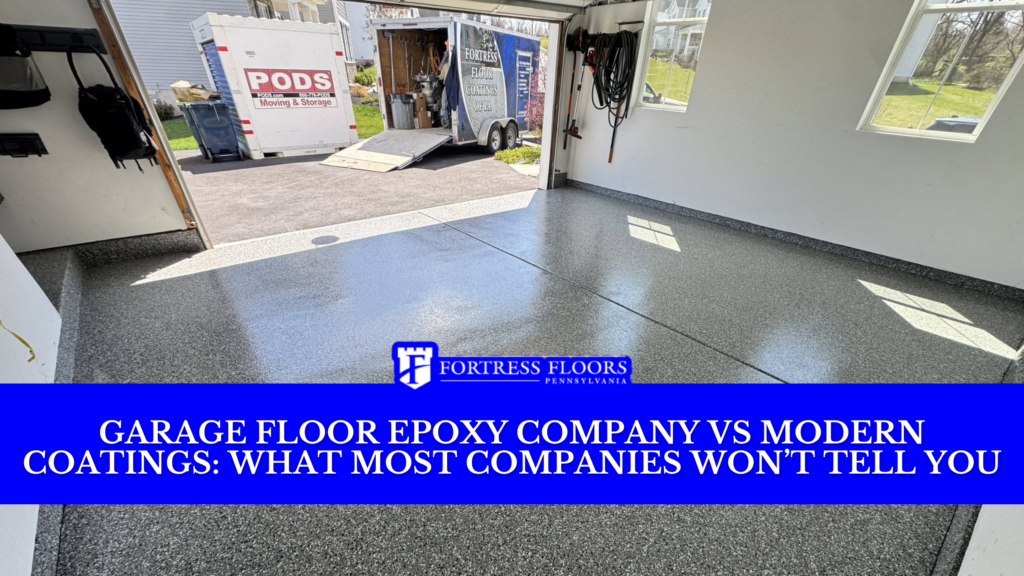
- 1-Day Installation: A complete multi-layer system installed in a single day so you can put your garage back together quickly.
- Custom Vinyl Flake Blends: A wide range of designer color chip combinations that disguise dirt and elevate your garage interior aesthetic.
- Slip-Resistant Texture: A textured polyaspartic topcoat that provides traction even when wet from snow, ice, or rain.
- Pennsylvania-Proof Durability: Engineered to withstand salt, automotive fluids, chemical spills, and extreme freeze-thaw cycles without chipping or peeling.
Ready to Upgrade Your Garage Floor?
Don’t fall for outdated promises or quick temporary fixes from a standard garage floor epoxy company. Choose a concrete coating system designed to flex with your slab, withstand real-world heat, and maintain its clear finish for years to come.
Contact the team at Fortress Floor Coatings today to request your free, no-obligation estimate and transform your garage floor in just one day.